Color is really a
sensation or impression, it is believed that it has our brain when it receives
information from the eyes. Travel electromagnetic waves through the air. These
waves come from the light that reflects the surfaces of the object.
Showing posts with label art. Show all posts
Showing posts with label art. Show all posts
Wednesday, 20 June 2018

Wednesday, 6 June 2018
Surfing
Surfing or boarding is a water sport that consists of sliding and turning in a wave, standing on a board.
There is evidence of the presence of surfing for more than 500 years on the islands of Polynesia. The English explorer James Cook arrived in the Hawaiian Islands in 1778.
On the other hand in the north of Peru, local cultures left traces that show men climbing waves. The huacos are pre-Inca ceramics and one of them clearly shows a man on a tree or something similar in an attitude of sliding on a wave.4 This would indicate that everything started in South America, but it was the Polynesians in their constant swells between islands, who some centuries later, took the custom of sliding waves to places like Hawaii.
With the contact, the native cultures were repressed and the surf happened to lose height. James Cook was later killed by the natives. In the twentieth century, surfing recovered and with the influx of American tourists and military in Hawaii and the fame of the Hawaiian Olympic Duke Kahanamoku, surfing began to become popular on the coasts of California and Australia, creating the germ of a subculture in the environments in which it was practiced extending then to other countries.
This happened in the 50s and 60s. Then the boards were large solid wood objects and surfing was a simple practice. Later it became more difficult thanks to the audacity of pioneers like Óscar Rodríguez, patriarch of modern surfing of big waves. There was also an evolution in acrobatics and movements as well as an investigation into new designs and board materials that would allow other expressions. Currently, competitive surfing is fundamentally based on:
• The design and materials researches of aeronautical engineers surfers looking for a hydrodynamic optimization of the boards.
• The current of Australian evolution of style (broad and energetic movements).
• In recent years, it has included influences from skateboarding and snowboarding - sports in turn based on surfing.
Surfing was known in the 60s in many countries on different continents. Currently, it is practiced in almost the entire world, although the most buoyant tables and accessories industries have their headquarters in Australia, southern Europe and the United States. Among the destinations most requested by practicing travelers are Australia and Southeast Asia. Surfing is a thriving sport also in Latin America in some areas of Peru, Chile, Mexico or Brazil, with a large number of beaches suitable and ideal for this sport

There is evidence of the presence of surfing for more than 500 years on the islands of Polynesia. The English explorer James Cook arrived in the Hawaiian Islands in 1778.
On the other hand in the north of Peru, local cultures left traces that show men climbing waves. The huacos are pre-Inca ceramics and one of them clearly shows a man on a tree or something similar in an attitude of sliding on a wave.4 This would indicate that everything started in South America, but it was the Polynesians in their constant swells between islands, who some centuries later, took the custom of sliding waves to places like Hawaii.
With the contact, the native cultures were repressed and the surf happened to lose height. James Cook was later killed by the natives. In the twentieth century, surfing recovered and with the influx of American tourists and military in Hawaii and the fame of the Hawaiian Olympic Duke Kahanamoku, surfing began to become popular on the coasts of California and Australia, creating the germ of a subculture in the environments in which it was practiced extending then to other countries.
This happened in the 50s and 60s. Then the boards were large solid wood objects and surfing was a simple practice. Later it became more difficult thanks to the audacity of pioneers like Óscar Rodríguez, patriarch of modern surfing of big waves. There was also an evolution in acrobatics and movements as well as an investigation into new designs and board materials that would allow other expressions. Currently, competitive surfing is fundamentally based on:
• The design and materials researches of aeronautical engineers surfers looking for a hydrodynamic optimization of the boards.
• The current of Australian evolution of style (broad and energetic movements).
• In recent years, it has included influences from skateboarding and snowboarding - sports in turn based on surfing.
Surfing was known in the 60s in many countries on different continents. Currently, it is practiced in almost the entire world, although the most buoyant tables and accessories industries have their headquarters in Australia, southern Europe and the United States. Among the destinations most requested by practicing travelers are Australia and Southeast Asia. Surfing is a thriving sport also in Latin America in some areas of Peru, Chile, Mexico or Brazil, with a large number of beaches suitable and ideal for this sport

Thursday, 24 May 2018


Monday, 7 May 2018
Pointillism or divisionism is a pictorial technique that consists of representing the luminous vibration through the application of points that, when viewed from a certain distance, make up well-defined figures and landscapes. In the paintings all the colors are pure and never mix with each other but it is the eye of the spectator who does it.
The points that make up the work have a similar size, so that the viewer can not fail to observe a perfection that makes one think of an idyllic frozen image, like a lasting vision of reality or image.
Pointillism is considered as the continuation of Impressionism, it moves away from it in the conception of forms and volumes, and that is in pointillism.
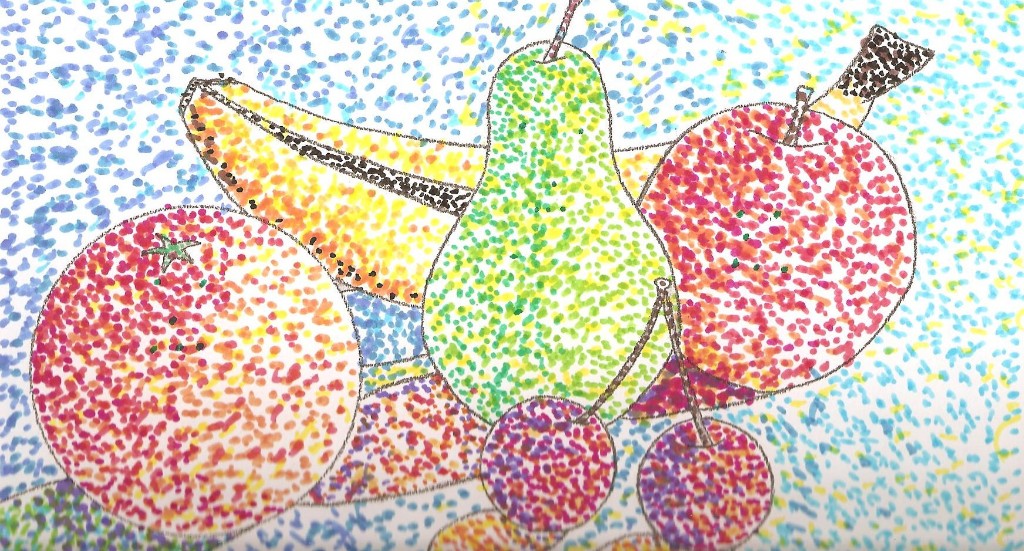
The points that make up the work have a similar size, so that the viewer can not fail to observe a perfection that makes one think of an idyllic frozen image, like a lasting vision of reality or image.
Pointillism is considered as the continuation of Impressionism, it moves away from it in the conception of forms and volumes, and that is in pointillism.
Pastels can be hard or soft. Soft pastels have more pigment and less binder, so they are easier to smudge and have brighter colors.Hard pastels can stay relatively sharp, so they are ideal for pastel artwork that requires tight detail. Hard pastels have less pigment and more binder than soft pastels.Pastel artwork can either be referred to as a “pastel”, a “pastel painting”, or a “pastel drawing”.
MAKING
1º Place powdered gum
tragacanth into a glass jar, add water and mix to dissolve. Close the jar and refrigerate it for at least 48 hours. The mixture will become a gelatinous solution

2º Place powdered pigment on a glass palette. Make a hole in the
middle of the pile of pigment. Pour a very small amount of the gum tragacanth
solution into the center of the pigment. Using a palette knife, mix the pigment
and the gum tragacanth solution.

3º Is
necessary, add more gum solution. Mix thoroughly until the mixture reaches a
doughy consistency.

4ºTo make a lighter shade of
blue, add a pile of white pigment to the remaning blue pastel. Add a small
amount of gum, and repeat the mixing process.

5º Mold
the doughy pastel into a stick from. Place the pastel on absorbent paper, such
as a paper towel. Allow the pastel to dry. You can create your pastels in any
shape that you want, depending on what you might want to use it for.

PIGMENTS
Until the middle of the last century, when it was discovered that aniline dyes were being made from coal tar, most of the dyes were obtained from natural species in plants or animals called carmine lakes. . There are two varieties of lake carmine, both produced from insects, cochineal lake and lake kermes, and both are used as dye and lake.
Lake Cochineal comes from the cochineal, native to the New World, which was used by the Aztecs to dye and paint and was brought to Europe in the sixteenth century after the Spanish conquest.

Lake Cochineal comes from the cochineal, native to the New World, which was used by the Aztecs to dye and paint and was brought to Europe in the sixteenth century after the Spanish conquest.

Wednesday, 7 February 2018
Vocabulary of Art
Polygons:
We learn learned how to do :
-Triangle , square , hexagon, pentagon ,hepatgon ,octogon and dodecagon.
Stars Polygons:
The polygons crashed can not get in the way you told abd not.
According to the number of vertices that a non-crashed polygon has, we can obtain none, one or several stars.
There are starry polygons that are called false stars because they are formed by two polygons.
I learn to do this stars : pentagon star , heptagon star , octogon star , dodecagon star.
Symmetric:
Symetrical balance:it is a way to organize parts of a image , picture or drawing so one side uplicates or mirrors the others . The opposite way is called asymmetrical balance .
Symetry:It is a quality os somme shapes which some of their parts are reflection of others
Reflection symmetric: it is a shapes quality which is formed by 2 halves facing each other whith an axis or fold line between as if both sides were mirror images of each other.
Symetri axis: It is a line which divides a sahpe into 2 parts symmetric halves. Every element of the shape is reflected on the other side and at same distance from the axis .Symmetric points are an perpendicular line ot it .
Central symetry: Its is a reflection of an object through a point called the symmeric center .Every symmetric point is on other side and at the same distace from the center symmetric . Symmetric pair of point are collinear whith the center.
Geometric symmetric : It is a kind symmetric followa accurately the geometric symmetric rules.
Apparent symmetric: It is a quality of shapes or objects which show anobvius symmetric , but not every points or elements followa accuarately the geometric symmetry rules .It happens ery frequently in nature.
We learn learned how to do :
-Triangle , square , hexagon, pentagon ,hepatgon ,octogon and dodecagon.
Stars Polygons:
The polygons crashed can not get in the way you told abd not.
According to the number of vertices that a non-crashed polygon has, we can obtain none, one or several stars.
There are starry polygons that are called false stars because they are formed by two polygons.
I learn to do this stars : pentagon star , heptagon star , octogon star , dodecagon star.
Symmetric:
Symetrical balance:it is a way to organize parts of a image , picture or drawing so one side uplicates or mirrors the others . The opposite way is called asymmetrical balance .
Symetry:It is a quality os somme shapes which some of their parts are reflection of others
Reflection symmetric: it is a shapes quality which is formed by 2 halves facing each other whith an axis or fold line between as if both sides were mirror images of each other.
Symetri axis: It is a line which divides a sahpe into 2 parts symmetric halves. Every element of the shape is reflected on the other side and at same distance from the axis .Symmetric points are an perpendicular line ot it .
Central symetry: Its is a reflection of an object through a point called the symmeric center .Every symmetric point is on other side and at the same distace from the center symmetric . Symmetric pair of point are collinear whith the center.
Geometric symmetric : It is a kind symmetric followa accurately the geometric symmetric rules.
Apparent symmetric: It is a quality of shapes or objects which show anobvius symmetric , but not every points or elements followa accuarately the geometric symmetry rules .It happens ery frequently in nature.
Saturday, 3 February 2018
Interlaced star
1º You make a 5-pointed star.
2º From all the tips link with the center.
3º From each point you make a line with a measure of compas
that you want.
4º You link.

Tuesday, 28 November 2017
Triangles and paralles


Wednesday, 1 November 2017
Halloween
USA:Halloween (31 october) is a celebration that takes place in the United States. It consists in the children dress up and go to the house and say trick or treat, the owners of the houses give them candies

Japan:The Halloween in Japan the sae of the uited states because they begins celebrate this fest at ten years ago,but the Japanese do the Halloween the diferent mode,they dont not have pumkins but they have gt costumes.

spain: in spain we celebrate hallowen bat is not very popular.we have costumes of zombies, witches,esqueletons...We go to the homes an sai truco o trato and the people of the home give them some candies .

My masks of halloween.


Sunday, 29 October 2017
My vocabulary of art
Geometry vocabulary
Point : can be a place or location in two lines, that are cut, neither size, nor depth and has no dimension. Is very small.
Point : can be a place or location in two lines, that are cut, neither size, nor depth and has no dimension. Is very small.
Point : has a lot of dimension.
ray :is a line that has a particular
point.
endpoint : the end point is the point with a line segment of a semirect.
Midpoint: is the point that is in the middle of the
endpoint of each end.
line segment: line with two endpoints.
straight line: line which the points follow in the same
direction.
plane : are two dimensions in n plane space can be defined as parallel or in a
frame.
Legth: measure of two things from end to
beginning.
Freehand :drawing without tools.
Compass :to make circles or take distances.
The circles vocabulary
Circle: set of points at the same distance os the center.
Cincurference: it is the full lengh of a circle , it is the line around a circle.
Center:is the point equidistant to any points on a circle .
Radius: it is the length of a line segment from center to its perimeter.
Diameter : it is a line segment past to the center and conects 2 points of a circle .
Chord: is a line that conect 2 points but not past to the center .
Arc: segment of a circle .
Arrow : perpendicular line from the middle of chord.
Tangent: it is a line that cut in only one point of a circle.
The polygons
Star polygons: is a particular polygon case with a star shape or form.
Inscribed polygons : they are polygons placed inside circles so all the verices of the polygons are placed on the circle.
Circumscribed polygons : they are polygons sorrounding a circle behing its sides tanget to the circles inside.
Equilateral: all ther cover , angles or vertices are equal.
Regular : all their vertices angles and sides are equal
Irregular: shpww different angles and lengths for their sides
The circles vocabulary
Circle: set of points at the same distance os the center.
Cincurference: it is the full lengh of a circle , it is the line around a circle.
Center:is the point equidistant to any points on a circle .
Radius: it is the length of a line segment from center to its perimeter.
Diameter : it is a line segment past to the center and conects 2 points of a circle .
Chord: is a line that conect 2 points but not past to the center .
Arc: segment of a circle .
Arrow : perpendicular line from the middle of chord.
Tangent: it is a line that cut in only one point of a circle.
The polygons
Star polygons: is a particular polygon case with a star shape or form.
Inscribed polygons : they are polygons placed inside circles so all the verices of the polygons are placed on the circle.
Circumscribed polygons : they are polygons sorrounding a circle behing its sides tanget to the circles inside.
Equilateral: all ther cover , angles or vertices are equal.
Regular : all their vertices angles and sides are equal
Irregular: shpww different angles and lengths for their sides
Subscribe to:
Posts (Atom)